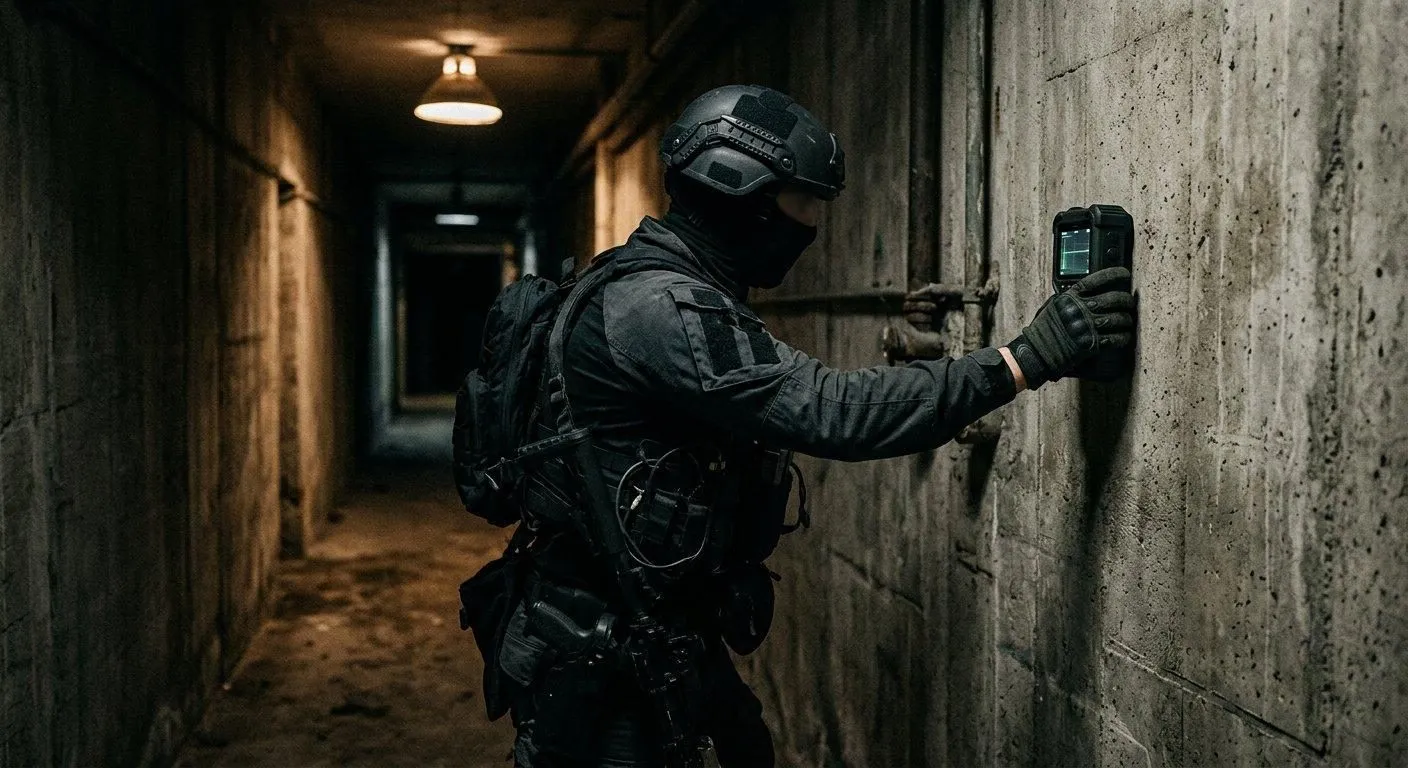
Through-Wall Radar - 3D Vision Beyond Walls, Explained on the PRO-Wall 3D Scan Example
PRO-Wall 3D Scan combines FMCW, MIMO, ultra-wideband radar and AI to detect up to five people, classify posture and track movement through walls at ranges up to 60 meters.
The idea of seeing people through walls moved from military laboratories to commercial devices in the early 2000s, when ultra-wideband radar hardware became small and affordable enough for handheld units. ProDefence positions PRO-Wall 3D Scan in this class: according to the vendor, the radar penetrates walls, detects up to five individuals, determines their posture and tracks their movements at distances of up to 60 meters, combining FMCW and MIMO radio techniques with AI-based processing.
Numbers of this kind always come with fine print, and this overview tries to supply it: how the underlying methods work, why wall material decides almost everything, who actually uses through-wall radar, and which questions separate a realistic specification from a marketing one.
Seeing through walls: an idea with a long history
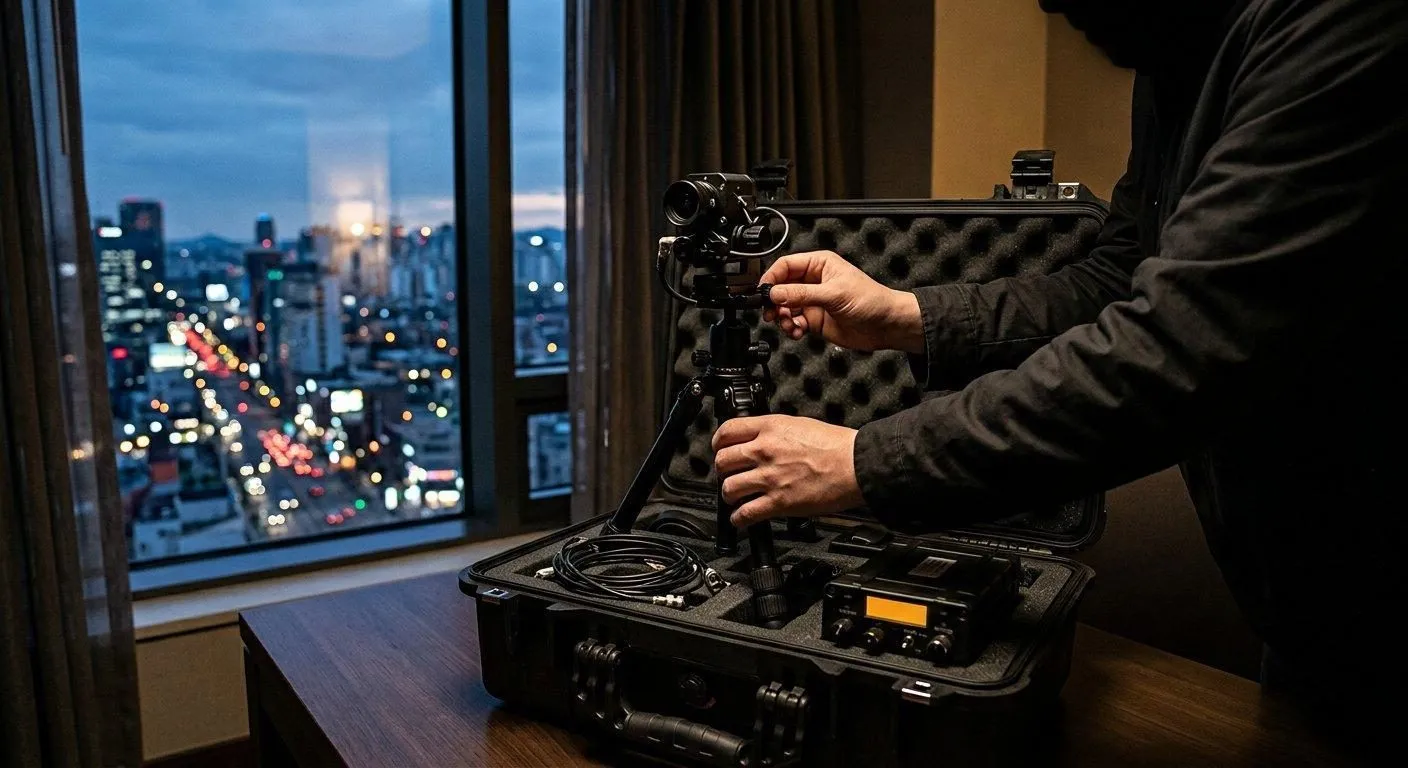
Radio waves below a few gigahertz pass through dry brick and concrete the way light passes through frosted glass: attenuated and scattered, but not stopped. Radar engineers exploited this in military research programs of the 1990s, and the first practical through-wall imagers appeared in the 2000s, aimed at close-quarters combat and hostage scenarios. Systems such as Camero's Xaver line and Vayyar's imaging chips defined what the commercial class looks like: a device pressed against a wall or held at a stand-off, painting human positions as icons or dots on a room plan.
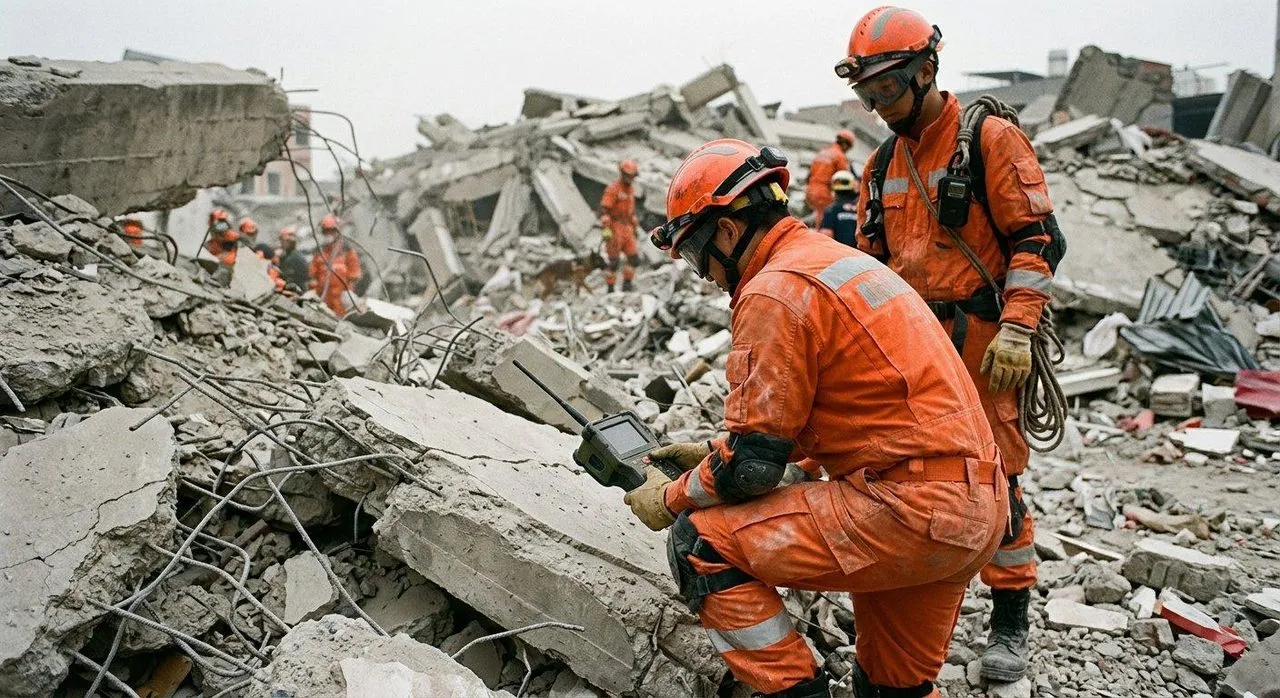
A parallel branch grew in search and rescue, where radar breathes life into rubble: after earthquakes and building collapses, detecting the micro-motion of breathing through concrete slabs can locate survivors when cameras and dogs cannot reach. PRO-Wall 3D Scan, as described by ProDefence, targets the security end of that spectrum - law enforcement, counter-terrorism, hostage rescue and urban warfare, with search and rescue explicitly included - and adds two modern ingredients: 3D imaging rather than flat dots, and AI processing on top of the raw radar picture.
What do FMCW, MIMO and UWB actually do?
Three acronyms describe how modern through-wall radars build their picture, and the vendor's page names all three. FMCW - frequency-modulated continuous wave - means the radar does not fire pulses but sweeps its frequency smoothly; comparing the outgoing and returning sweeps yields distance with high resolution. UWB - ultra-wideband - describes how wide that sweep is: the wider the bandwidth, the finer the detail, and low UWB frequencies penetrate dielectric walls better than the narrow, high-frequency carriers used for classic radar.
MIMO is the geometric half: many transmit and receive antennas measure the same scene from slightly different positions, and combining those views produces angular resolution - left-right and up-down. FMCW gives depth, MIMO gives angle, and the fusion is a three-dimensional point cloud of reflections. The final named ingredient, AI processing, is what turns that noisy cloud into statements an operator can act on: separating human micro-Doppler signatures from fans and curtains, classifying posture, and holding tracks on several people at once. Each layer is established technology; the art lies in keeping the whole chain working after the signal has crossed a wall twice.
What the operator sees - and what stays invisible
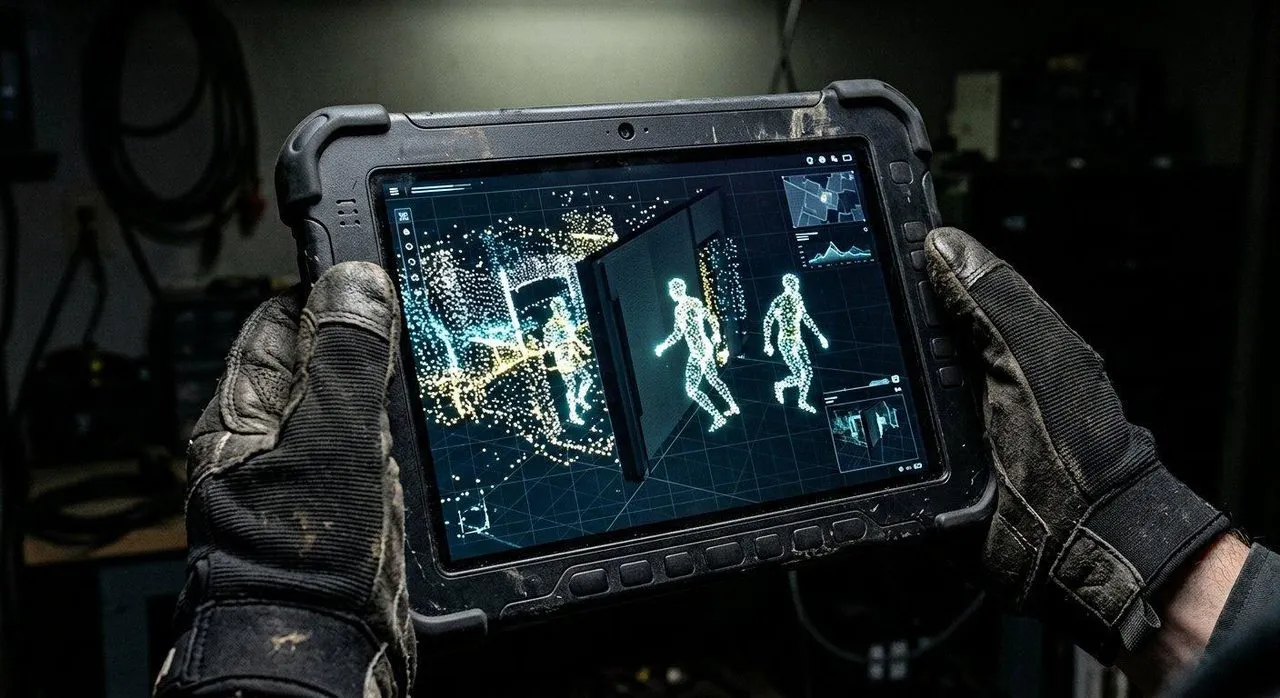
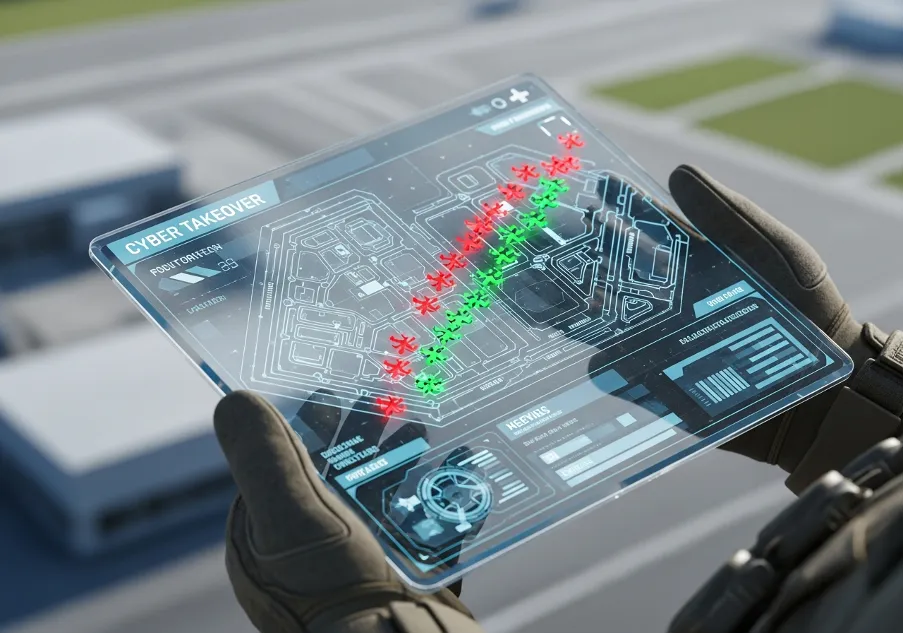
The realistic output of this class is not a video image through the wall. It is a room map with markers: how many people, where, whether standing, sitting or lying, and how their positions change second by second. Posture classification rests on the shape of the reflected micro-Doppler signature, and static detection - finding a person who is not moving at all - works through the small periodic motion of breathing, which is exactly the capability search-and-rescue variants rely on.
Equally important is what remains invisible: faces, identity, clothing and objects below the resolution limit do not exist in this picture. The vendor's two headline figures deserve the same careful reading. "Up to five individuals" is a track capacity - how many people the software can hold apart in one scene. "Up to 60 meters" describes reach under favorable conditions: every real wall between the radar and the target subtracts from that reach, because the signal must cross the barrier twice. An open-air or drywall scenario and a basement with reinforced concrete are different worlds for the same device.
Who uses through-wall radar - and what breaks it
The named user groups on the ProDefence page match the established market for the class:
- Hostage rescue - locating captives and captors before entry, and watching the scene during negotiation.
- Counter-terrorism and special response - checking rooms, stairwells and adjoining apartments before a breach.
- Urban operations - confirming whether a building is occupied or abandoned without entering it.
- Search and rescue - finding survivors by breathing motion under debris where there is no line of sight.
- Custody and transport security - screening confined spaces and vehicles for hidden persons.
The failure modes are just as characteristic. Reinforced concrete with dense rebar, metal cladding and foil insulation reflect the signal instead of passing it; thick wet masonry soaks it up. Moving clutter - a fan behind the wall, a curtain in a draught - competes with human signatures, and the operator's own handedness matters: reading a live radar picture is a trained skill. This is why serious vendors of the class publish range per wall type rather than a single heroic number; the single number almost always refers to the friendliest wall.
How do you verify a vendor's claims?
Through-wall radar sits in a sensitive legal zone. In several countries, courts have treated sensors that reveal the interior of a home as searches requiring authorization, so doctrine and logging matter as much as hardware. On the technical side, the questions that expose a realistic specification are remarkably concrete:
- What is the measured range per wall type - drywall, brick, block, reinforced concrete - from instrumented tests, not simulations?
- Does the system detect a motionless person via breathing, at what range, and after what dwell time?
- How many simultaneous tracks hold up with real people walking, and what is the false-alarm behavior against moving clutter?
- What are latency and refresh rate of the 3D picture, and how is posture confidence shown to the operator?
- What does the device log for after-action review or court use - tracks, timestamps, operator actions?
- What are the weight, setup time and battery life for the stated configuration?
PRO-Wall 3D Scan, as publicly described, assembles the standard modern recipe - FMCW for range, MIMO for angle, AI for interpretation - and quotes class-typical ambitions: five tracked individuals, posture, 60 meters. The experience of two decades of this technology suggests the honest summary: against ordinary walls it is a genuine tactical advantage, against reinforced ones a limited tool, and in all cases a sensor whose value is set by test data per wall type, operator training and the legal frame it works in - not by the largest number on the page.



















Trusted Worldwide
Operating in more than 50 countries, we provide cutting-edge defense solutions that ensure your safety to every corner of the globe.
Get Advice From Our Experts
Please complete the feedback form to gain exclusive access to our catalog showcasing models that are not available on our website
We’re here to assist you with any inquiries, support, or information you need. Whether you're interested in our defense products, looking to collaborate, or simply have a question, our team is ready to help.